TELEMECANIQUE LP1K0610BD General Ac Drives
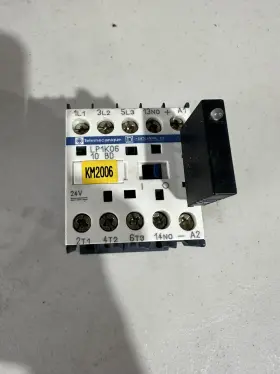
( Brand: Telemecanique ), ( Model: TELEMECANIQUE LP1K0610BD ), ( Part Type: Ac Drive ), ( Manufacturer Part Number: LP1K0610BD )
Review TELEMECANIQUE
The Telemecanique LP1K0610BD is a versatile and reliable contactor designed for various automation applications. This contactor, manufactured by Schneider Electric, is part of the Telemecanique Kobold range, known for its robustness and durability.
The LP1K0610BD is a single-phase, normally-open (NO) contactor, rated for an operating voltage of 230V and a current capacity of 10A. It features a silver-plated copper contact surface that ensures excellent conductivity and long contact life. The contactor is also rated for a thermal load of 2 kW, making it suitable for applications with higher power demands.
The LP1K0610BD comes with a built-in coil that enables the contactor to be operated remotely. The coil has a rated voltage of 230V and a current of 0.35A. The contactor also features a lockout function that prevents inadvertent operation during maintenance or repair work.
The contactor housing is made of die-cast aluminum, which provides good heat dissipation and protects the internal components from harsh environments. The LP1K0610BD is suitable for installation in panel mounting applications and features a compact size of 60 x 62 x 32 mm.
The contactor comes with a transparent protective cover that shields the contact area from dust, moisture, and other contaminants. The cover also allows for easy visual inspection of the contact area, making it an ideal choice for applications where maintenance and monitoring are essential.
The LP1K0610BD is designed to meet the highest safety standards and is compliant with various certifications, including CE, UL, and CSA. It is also RoHS and WEEE compliant, making it an environmentally-friendly choice for automation applications.
In summary, the Telemecanique LP1K0610BD is a robust and reliable contactor that offers excellent conductivity, long contact life, and easy maintenance. Its compact size, built-in coil, and lockout function make it a versatile choice for various automation applications, while its compliance with various safety standards and certifications ensures peace of mind for users.
The Telemecanique LP1K0610BD is a contactless proximity sensor designed for various automation applications. Here are some pros and cons to help you decide whether this sensor is suitable for your project:
Pros:1. Contactless Technology: The LP1K0610BD uses contactless proximity sensing technology, which eliminates the need for mechanical contacts and reduces wear and tear. This can lead to increased reliability and longer lifespan.
2. Wide Detection Range: The sensor has a wide detection range of up to 50mm, making it suitable for various applications where objects of different sizes need to be detected.
3. Versatile: The LP1K0610BD can be used in various industries, including manufacturing, logistics, and automotive, making it a versatile choice for automation projects.
4. Easy Installation: The sensor is easy to install and requires no external power supply, as it can draw power from the control device.
5. High Resolution: The LP1K0610BD has a high resolution, which allows it to detect small objects and distinguish between similar objects.
Cons:1. Limited Mounting Options: The sensor can only be mounted in a specific way, as it requires a clear view of the detection area. This can limit the flexibility of installation.
2. Sensitivity: The LP1K0610BD has a relatively low sensitivity, which means that it may not detect objects that are too far away or too close. This can be a limitation in certain applications where precise detection is required.
3. Dependence on Control Device: The sensor requires a control device to function, which can add to the overall cost and complexity of the project.
4. Limited Operating Temperature: The LP1K0610BD has a limited operating temperature range of -10 C to 60 C, which can be a limitation in extreme temperature environments.
Conclusion:The Telemecanique LP1K0610BD contactless proximity sensor offers several advantages, including wide detection range, versatility, easy installation, and high resolution. However, it also has some limitations, such as limited mounting options, sensitivity, dependence on a control device, and limited operating temperature range.
Based on the information provided, I would recommend considering the LP1K0610BD for applications where contactless sensing is required, and a wide detection range is desirable. However, if precise detection is required, or the operating temperature is extreme, other sensor types may be more suitable. Additionally, it's important to consider the overall cost and complexity of the project when deciding whether to use this sensor.
Details:
part #: lp1k0610bd prices
- $45.00-$60.00
specifications acdrivestream:
- brand: Telemecanique
- model#: TELEMECANIQUE LP1K0610BD
- part type: Ac Drive
- manufacturer part number: LP1K0610BD
returns acdrivestream:
- time: 30 Days
- policy: Returns Accepted
- paid by: Buyer
- method: Money back
general acdrivestream:
- Drives Starters > Drives Motor Controls > General Purpose AC Drives
- condition: Used
shipping acdrivestream:
- type: Calculated
- service: UPS Ground
- transit: 4-10 Days
- class: Standard
- cost: $10.41
- carrier: UPS
payments acdrivestream:
- other
- wallet: Apple-pay
- credit card: Diners-club
seller acdrivestream:
- city: Placentia, California
- # reviews: 22
- rating: 100.0%
offer acdrivestream:
- availability: In Stock
- options: Ship-to-home
- started: September 8, 2025
- sold: 0
- quantity: 3
Telemecanique LP1K0610BD Is Similar To:
- Telemecanique Atv18u29n4 Altivar 18 Vfd Drive 0.5-320hz 380 460v-ac 2hp (35.8% similar) Valve bodies and manifolds. Gear reducers. Knife gate valves. Cooling fans. Heating and cooling. Circuit breakers...(June 6th, 2024)
- Telemecanique Atv16u29m2q Ac Drive (55.2% similar) height - 21.000CM. Manufacturer part number: ATV16U29M2Q. Ryan MRI sells factory new and pre-owned surplus products develops channels to purchase such product...(June 21st, 2024)
- Telemecanique Atv28hu18s6xu Ac Drive Input 575 Vac 1.5 Amp 0.75 Kw 1 Hp (37.9% similar) Ryan MRI sells factory new and pre-owned surplus products develops channels to purchase such product. Manufacturer part number: ATV28HU18S6XU...(June 21st, 2024)
- Telemecanique Atv31hu40s6x Schneider Altivar31 Ac Drive 4kw 5hp 600vac (38.3% similar) Manufacturer part number: ATV31HU40S6X. Ryan MRI sells factory new and pre-owned surplus products develops channels to purchase such product. height - 21.000CM...(June 22nd, 2024)
- Telemecanique Atv-31c037m2 Atv31c037m2 Ip54 Ac Drive 1phase 208-240vac 5 Hp (36% similar) Condition used. Bank transfer. Mpn ATV-31C037M2 ATV31C037M2. Manufacturers warranty and support do not apply...(July 12th, 2024)
- Telemecanique Atv11hu09m2e Altivar 11 5hp Ac Drive (45.3% similar) The altar 11 is a reliable and durable drive that built to last. With a maximum output power of 0.5HP, this drive is ideal for industrial automation and motion control applications. It has a input voltage of 240V and is manufactured in France by Telemecanique...(July 21st, 2024)
- Telemecanique Atv16u41n4 5.8a 460v 3hp 2.2kw Altivar 16 Sa Square D Ac Drive (36% similar) The unit type is a standalone and the model altar 16. With a maximum load of 3 hp and an input voltage 460 v, it is suitable for variety industrial equipment. This Telemecanique altar 16 ac drive is a reliable and efficient choice for industrial automation motion control applications...(July 21st, 2024)
- Telemecanique Atv151u22mo Warranty Fast Shipping (43.2% similar) Part #: Telemecanique ATV151U22MO for sale...(July 21st, 2024)
- Telemecanique Atv61hd11n4 Warranty Fast Shipping (45.9% similar) Part #: Telemecanique ATV61HD11N4 for sale...(July 25th, 2024)
- Telemecanique Atv58hu18n4s Z Ac Drive Output 400 460v 0.1-500hz 3 Phase Class 20 (32.7% similar) Plastic outer cover not available. Telemecanique ATV58HU18N4S z ac drive output 400/460V 0.1-500HZ 3 phase class 20. Used working condition. Condition notes: sold as inner drive components only...(August 2nd, 2024)
- Telemecanique Atv58hu29n4zus Ac Drive Class 20 Output 400 460v 0.1-500hz 3 Phase (30.8% similar) Used working condition. Telemecanique ATV58HU29N4ZUS ac drive class 20 output 400/460V 0.1-500HZ 3 phase. Does not have plastic outer shell. Condition notes: being sold as inner unit drive only...(August 2nd, 2024)

5 offers $45.00–$60.00 USD
- New – Open box. Offer #1 priced at $58.00 + $0.00 delivery = $58.00* total. FREE SHIPPING
- Used. Offer #2 priced at $45.00 + $10.95 delivery = $55.95* total. The 3-pole contactor is suitable for business and industrial applications, and its brand Telemecanique is known for producing high-quality electrical equipment and supplies. This Telemecanique 6AMP 3P Contactor is a reliable and efficient definite purpose contactor suitable for various electrical equipment and supplies.+$10.95 shipping
- New – Open box. Offer #3 priced at $60.00 + $16.50 delivery = $76.50* total. New Surplus--Opened Factory Box----4/22/WW---6/22/KF-5/23JLV.+$16.50 shipping
- Used. Offer #4 priced at $43.65 + $79.80 delivery = $123.45* total. Please meet us an e-mail to request the shipping Costs outside Europe.+$79.80 shipping
- New – Open box. Offer #5 priced at $60.00 + $0.00 delivery = $60.00* total. CONTACTOR, 24V.FREE SHIPPING